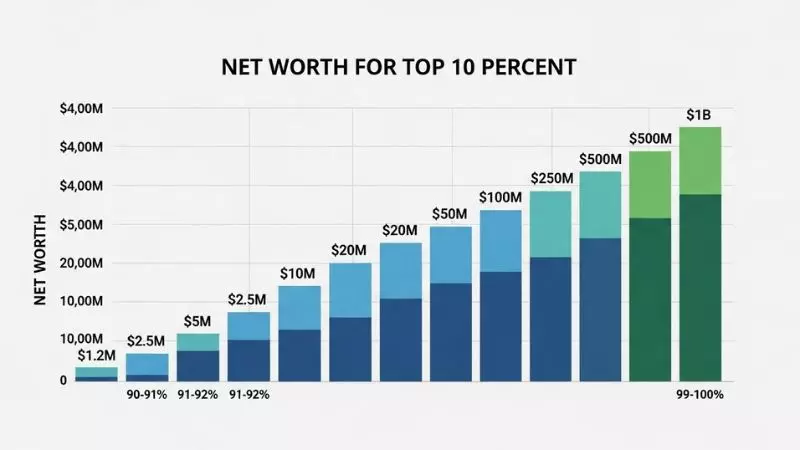
Understanding Net Worth for Top 10 Percent is crucial for anyone aiming to gauge financial success and wealth benchmarks. This metric reveals how assets, investments, and savings compare with the broader population. Tracking wealth accumulation, financial security, and asset growth helps households plan long-term financial goals effectively.
What Is Top Percent Net Worth?

Net worth is one of the most important measures of personal wealth. When we talk about top percent net worth we refer to how wealthy someone is compared to the general population. This concept is widely used by economists, financial planners, and researchers to understand wealth distribution.
In simple terms net worth equals:
- Total assets (cash, investments, property, retirement funds)
minus - Total liabilities (debts, loans, mortgages)
Top percent net worth shows where an individual or household stands in the overall wealth ladder. People in the top 1 percent, 5 percent, or 10 percent have more wealth than most others in the same society.
Key comparison terms related to net worth
- Wealth percentile ranking
- Household net worth distribution
- Income versus wealth differences
- Median net worth vs top percent net worth
Understanding these concepts helps you benchmark financial goals, investment planning, and long‑term financial security.
What Does Top 1 Percent Net Worth Mean
The top 1 percent net worth refers to the wealth level needed to be in the highest 1 percent of the population in a given country.
People in the top 1 percent typically have:
- High net worth from diversified assets
- Significant investment portfolios
- Property holdings and business ownership
- Lower debt relative to their assets
Typical characteristics
- Substantial retirement and investment accounts
- Multiple income streams
- Access to tax efficient strategies
- Strong intergenerational wealth transfer
Example of what top 1 percent net worth indicates
- It shows extreme wealth concentration
- Indicates wealth inequality levels
- Is often used in economic reports and financial studies
What Does Top 5 Percent Net Worth Mean
Being in the top 5 percent net worth group means an individual or household has more wealth than 95 percent of the population. This group includes:
- Successful business owners
- High earning professionals
- Long‑term investors
- Tech founders and executives
Main features of top 5 percent wealth
- Net worth significantly higher than median or average
- Strong investment portfolios
- Valuable real estate and retirement savings
This wealth tier represents upper middle class to affluent groups whose assets grow faster due to compound returns, inheritance, and strategic financial planning.
What Does Top 10 Percent Net Worth Mean
The top 10 percent net worth represents the wealth level above nearly 90 percent of households. People in this group may not be ultra‑rich, but they are financially secure and often financially independent.
Typical traits of top 10 percent net worth
- Strong savings and investment discipline
- Ownership of property and retirement accounts
- Lower consumer debt relative to assets
- Potential business interests
Here is an illustrative table showing net worth thresholds by percentiles (note values are for example purposes and vary by country and year datasets):
| Percentile Group | Approximate Net Worth Threshold | Typical Asset Composition |
| Top 1 Percent | $10 Million + | Stocks, real estate, business interests |
| Top 5 Percent | $2 Million to $10 Million | Home equity, investments, retirement funds |
| Top 10 Percent | $1 Million to $2 Million | Retirement accounts, savings, property |
This table helps you understand where you might stand in terms of wealth compared to most individuals.
How Is Average Net Worth Calculated
Average net worth measures the total net worth of a group divided by the number of households in that group. It is a key financial statistic used by economists and financial analysts.
Calculation method
- Add total assets of all individuals or households.
- Add total liabilities for the same group.
- Subtract total liabilities from total assets to get net worth.
- Divide net worth by total number of people or households.
Formula
Average Net Worth equals:
Total Assets minus Total Liabilities
divided by
Number of Households
Why average net worth matters
- Shows the general wealth level of a population
- Helps compare wealth across regions or time periods
- Assists in economic policymaking and retirement planning
Difference between average and median net worth
- Average net worth can be skewed by extreme wealth at the top
- Median net worth represents the middle value and is often lower than average in societies with wealth inequalit
Net Worth Required for Top Percentiles
Understanding net worth required for top percentiles is essential for anyone who wants to benchmark their wealth against broader populations. Net worth percentiles measure how your assets minus liabilities compare to others. These percentiles help identify financial milestones and guide long-term wealth planning.
Key concepts:
- Assets: Savings, investments, real estate, business holdings.
- Liabilities: Debts, mortgages, loans, credit obligations.
- Net Worth Percentile: Position of an individual or household relative to the population.
By understanding these benchmarks, you can evaluate your current financial position and plan to grow your wealth over time.
Net Worth for Top 1 Percent
The top 1 percent net worth represents the wealthiest households in a country. These individuals hold significant assets across investments, property, and business ventures.
Key characteristics:
- Minimum net worth: around $13 million
- Diversified asset portfolios with high-value investments
- Property holdings and multiple income streams
- Financial independence and wealth preservation strategies
Net Worth for Top 2 Percent
The top 2 percent is slightly broader than the top 1% but still represents extremely wealthy households.
- Typical net worth: approximately $3 million or more
- Strong investment portfolios and property ownership
- Often includes successful entrepreneurs and top professionals
- Access to advanced financial planning tools
Net Worth for Top 5 Percent
Being in the top 5 percent indicates a very comfortable financial status, often with long-term financial security.
- Approximate net worth: $1.17 million to $3.5 million
- Includes retirement accounts, investment portfolios, and home equity
- Many in this bracket achieve early financial independence
- Stable cash flow and minimal high-interest debt
Net Worth for Top 10 Percent
The top 10 percent net worth is a commonly recognized measure of affluence.
- Typical net worth: $970,000 to $1.9 million
- Represents households with strong savings and asset growth
- Includes professionals, small business owners, and long-term investors
- Focus on wealth preservation and steady investment growth
Top 0.1 Percent Net Worth
The top 0.1 percent represents ultra-wealthy households with extraordinary financial influence.
- Net worth: $50 million or more
- Wealth largely from business ownership, investments, and large estates
- Holds a significant portion of national and global wealth
- Strategic tax planning and generational wealth transfers
Top 20 Percent Net Worth
The top 20 percent encompasses households that are financially secure and above the average population in assets.
| Percentile | Approximate Net Worth Threshold | Wealth Profile |
| Top 1% | $13,666,000+ | Ultra-wealthy, diversified assets |
| Top 5% | $3,500,000+ | High net worth, multiple income sources |
| Top 10% | $1,900,000+ | Affluent, solid investment portfolios |
| Top 20% | $850,000+ | Upper-middle class, stable finances |
This group enjoys financial stability, investment opportunities, and access to wealth-building resources.- Provides insight into broader wealth distribution and national economic dynamics.
Net Worth by Age (Top Percent)
Net worth increases with age due to career growth, investments, and asset accumulation. Understanding net worth by age for top percentiles helps plan financial goals, retirement, and wealth growth strategies.
Net Worth for Top 1 Percent by Age
Net worth thresholds for the top 1% by age rise as people accumulate assets over time.
| Age Group | Approximate Top 1% Net Worth |
| 18–24 | $650,000 |
| 25–29 | $2,100,000 |
| 30–34 | $2,600,000 |
| 35–39 | $4,700,000 |
| 40–44 | $7,800,000 |
| 45–49 | $8,700,000 |
| 50–54 | $13,200,000 |
| 55–59 | $15,300,000 |
| 60–64 | $17,800,000 |
| 65–69 | $22,100,000 |
Younger adults need relatively lower net worth to reach top 1%.- Older adults accumulate wealth through career, investments, and property ownership.
Net Worth for Top 10 Percent by Age
The top 10 percent by age shows how households build wealth steadily across life stages.
| Age Group | Approximate Top 10% Net Worth |
| 18–29 | $280,000 |
| 30–39 | $710,000 |
| 40–49 | $1,310,000 |
| 50–59 | $2,630,000 |
| 60–69 | $3,000,000 |
| 70+ | $2,860,000 |
- Younger households reach top 10% with modest savings.
- Middle-aged and older adults hold greater net worth from investments, retirement funds, and real estate.
Country-Wise Top Percent Net Worth Comparison
Net Worth for Top 10 Percent in the United States
| Percentile | Estimated Net Worth |
| Top 10% | High |
| Top 5% | Very High |
| Top 1% | Ultra High |
Net Worth for Top 10 Percent in India
| Percentile | Estimated Net Worth |
| Top 10% | Moderate |
| Top 5% | High |
| Top 1% | Very High |
Net Worth in Pakistan
| Percentile | Estimated Net Worth |
| Top 10% | Growing |
| Top 5% | High |
| Top 1% | Elite |
Global Net Worth Rankings

Global net worth rankings show how individuals and households compare internationally in terms of wealth. These rankings provide insight into wealth distribution, economic inequality, and financial benchmarks across countries. Understanding these rankings helps investors, financial planners, and curious readers benchmark their own net worth globally.
Key considerations for global net worth:
- Currency differences: Wealth is often measured in USD for comparison.
- Assets included: Real estate, investments, business holdings, and savings.
- Liabilities: Outstanding debts and loans are subtracted to calculate net worth.
- Wealth concentration: The richest individuals often hold a disproportionate share of global wealth.
Net Worth of Top 1 Percent in the World
The top 1 percent globally represents the wealthiest individuals whose net worth far exceeds typical household averages.
- Estimated threshold: $8 million to $10 million USD
- Wealth sources include business ownership, stock investments, luxury real estate, and passive income.
- Members of this group often have global investments and multi-country assets.
Key traits of top 1 percent globally:
- Ownership of multinational businesses or high-value startups
- Significant financial and investment portfolios
- Minimal high-interest debt and focus on wealth preservation
- Access to elite financial advisory and tax planning strategies
Net Worth of Top 5 Percent in the World
The top 5 percent globally is broader but still represents significant wealth accumulation.
- Approximate net worth: $2 million to $8 million USD
- Includes successful entrepreneurs, executives, and investors.
- Households in this percentile often enjoy high levels of financial security and access to quality investment opportunities.
Features of top 5 percent globally:
- Diversified portfolio of stocks, bonds, and real estate
- Significant retirement and savings accounts
- Financial independence and ability to leverage capital for business ventures
Top Net Worth in Pakistan
Net worth rankings in Pakistan highlight the wealthiest individuals and families within the country. They provide insight into local wealth concentration, major industries, and financial influence.
Key considerations:
- Most wealth in Pakistan is concentrated in business families, industrialists, and large-scale entrepreneurs.
- Wealth is often tied to real estate, textile, energy, and stock market holdings.
- Economic factors like inflation, currency fluctuations, and investment growth impact net worth significantly.
Top 10 Net Worth in Pakistan
The top 10 wealthiest individuals in Pakistan typically have net worth ranging from $500 million to $4 billion USD.
Table: Illustrative Top 10 Net Worth in Pakistan
| Rank | Individual / Family | Estimated Net Worth (USD) | Key Industry / Asset |
| 1 | Business Tycoon A | $4 Billion | Industrial, Real Estate |
| 2 | Business Tycoon B | $3.2 Billion | Textiles, Energy |
| 3 | Business Tycoon C | $2.8 Billion | Real Estate, Finance |
| 4 | Business Tycoon D | $2.5 Billion | Energy, Manufacturing |
| 5 | Business Tycoon E | $2 Billion | Consumer Goods |
| 6 | Business Tycoon F | $1.8 Billion | Agriculture, Investment |
| 7 | Business Tycoon G | $1.6 Billion | Technology & Investments |
| 8 | Business Tycoon H | $1.3 Billion | Textiles & Trade |
| 9 | Business Tycoon I | $1 Billion | Real Estate & Finance |
| 10 | Business Tycoon J | $900 Million | Manufacturing & Retail |
These individuals influence local economies and industries significantly.- Wealth accumulation is often generational with strong family business structures.
Net Worth of Pakistan 2022 (Contextual Reference)
By 2022, Pakistan’s total wealth distribution revealed:
- Top 1% of the population held approximately 43% of national wealth.
- Top 5% held around 60% of the total assets.
- Average household net worth remains much lower, highlighting significant wealth inequality.
Important observations:
- Real estate remains the largest asset for wealthy households.
- Industrialists and investors dominate the wealth landscape.
- Currency devaluation and inflation affect local net worth values over time.
Final Words
Achieving the Net Worth for Top 10 Percent is a realistic financial milestone for ambitious individuals and households. It reflects asset growth, strategic investments, and financial planning. Understanding these benchmarks allows you to measure progress against broader wealth standards and make informed decisions to secure your financial future. Tracking investments, property, and savings can help climb into this elite group, ensuring long-term stability and wealth growth.
Frequently Asked Questions
What is the Net Worth for Top 10 Percent?
The Net Worth for Top 10 Percent typically ranges from $900,000 to $2 million, including assets minus liabilities.
How much do you need to be in the Top 10 Percent?
Households generally need a net worth above $1 million to be in the top 10 percent of wealth holders.
Who falls into the Top 10 Percent Net Worth group?
Professionals, business owners, and long-term investors with diversified assets are usually in this group.
What assets contribute to the Top 10 Percent Net Worth?
Investments, retirement accounts, real estate, and savings are the main contributors.
How does debt affect Top 10 Percent Net Worth?
High liabilities can lower net worth, but households in the top 10 percent typically have manageable debt relative to assets.
What is the average age for Top 10 Percent Net Worth earners?
Most individuals reach this wealth level between ages 40 and 60 due to career progression and investment growth.
How does Top 10 Percent Net Worth compare globally?
Globally, top 10 percent thresholds vary but typically include net worth over $1 million adjusted for currency and living standards.
Why is understanding Top 10 Percent Net Worth important?
It helps benchmark personal wealth, set financial goals, and plan long-term investments for financial security.

Chriselle Lim is a passionate digital creator and lifestyle blogger based in California, USA. As the voice behind Blogzeno, she shares creative captions, inspiring Instagram bios, insightful celebrity stories, and simple insurance guides designed for everyday readers. Emily believes that words have the power to connect people whether it’s through a perfect caption or a helpful article.
With years of experience in online writing and content strategy, Emily’s mission is to make information both useful and enjoyable. Her work blends creativity with clarity, helping readers express themselves confidently and stay informed about what truly matters.
When she’s not writing, you’ll find her exploring photography, social media trends, and new ways to inspire digital creators worldwide. Follow her journey on Blogzeno — where creativity meets everyday life.